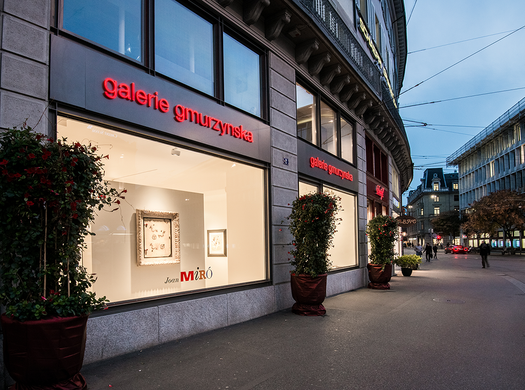
Paradeplatz 2
8001 Zurich
T +41 44 2 26 70 70
F +41 44 2 26 70 90
Mon–Fri, 10 – 6.30 PM
Sat, 10 – 4 PM


 test
test


Kurt Schwitters: Merz, exhibition design by Zaha Hadid
Galerie Gmurzynska Zurich, 2016
Galerie Gmurzynska is an international art gallery with locations in Switzerland in Zurich as well as the Galerie Gmurzynska US Inc. in the United States in New York. The gallery specialises in 20th century Modern and Contemporary Classics.
The gallery was founded in 1965 in Cologne, Germany by the Polish born Antonina Gmurzynska. From the beginning, the gallery was interested in organizing exhibitions that had a documentary character both through the choice of themes and through its publications. In its first year, an important exhibition of Japanese art from the 14th to the 19th century was held followed by an exhibition of French masterpieces from Pierre Bonnard up until the mid 20th century. The following year the gallery presented the work of David Burliuk – the first Avant-garde exhibition.
Up until 1971 the gallery’s program focused on Surrealism and international Constructivism and the Avant-garde. Subsequently, classic Modern art with a special focus on Picasso, Kurt Schwitters, Fernand Léger, Lyonel Feininger, and Robert and Sonia Delaunay were incorporated into the gallery’s program.

Judd / Malevich
Galerie Gmurzynska Zurich, 2017
Inauguration of additional space at Talstrasse 37 in Zurich
From 1986 Krystyna Gmurzynska continued expanding the gallery’s classic modern program and in 1991 the gallery’s new Cologne building constructed by the Swiss architect, Roger Diener, was inaugurated. In 1993 the gallery expanded to a second location to a 14th century building in the heart of Zug, Switzerland. This building has given the gallery the opportunity to experiment with new exhibitions such as the French born Yves Klein and the Ukrainian born Kazimir Malevich or Aspects of Futurism in 1995, by juxtaposing modern and contemporary art with classic architectural elements of the Zug space. In 1996 Mathias Rastorfer became a partner of both extensions of the gallery, having been with it since 1991 when he left his position as Associate Director at Pace Gallery in New York. Under his influence and in addition to the gallery’s traditional repertoire, the work of contemporary artists such as Donald Judd, Louise Nevelson and Yves Klein amongst others, were incorporated. Ten years later the gallery opened its third branch in St. Moritz at Via Serlas, in 2003.
Forty years after its establishment, Krystyna Gmurzynska and Mathias Rastorfer relocated the gallery from Cologne to its new flagship location in Zurich’s Paradeplatz in 2005. The building that currently houses the gallery dates back to 1857 and it is the same block in which the Dada movement was founded in 1917, presenting its first exhibition at Galerie Dada. The first exhibition in Zurich was a solo exhibition by Alexander Calder, entitled The Modernist, that was executed in close collaboration with the Calder Foundation, who described it is as “rare to experience a presentation of this quality outside of a museum”. As with each exhibition at the gallery the show featured a fully illustrated catalogue with important essays.

Robert & Sonia Delaunay
Galerie Gmurzynska Cologne, 1997
Known for its museum quality and uniquely curated exhibitions, Galerie Gmurzynska has hosted well over 200 shows in its various premises and published over 300 art historical catalogues and catalogue raisonné in close collaboration with experts worldwide. Moreover, the gallery has represented the estates of some of the world’s greatest artists such as Yves Klein, Louise Nevelson, Wifredo Lam and Roberto Matta, in some cases for several generations. Furthermore, the gallery represents contemporary artists Robert Indiana, Christo and Ronnie Cutrone among many others.
Galerie Gmurzynska continues to present unique exhibitions that are both historically well researched and scientifically documented. It also continues to work with leading art historians as well as collaborating with museums on exhibitions and for the enlargement of their permanent collections. Art Fair participations included and include among others, Art Basel Switzerland, Art Basel Miami Beach, Art Basel Hong Kong, TEFAF Maastricht and TEFAF New York, FIAC, Frieze Masters, EXPO Chicago etc.
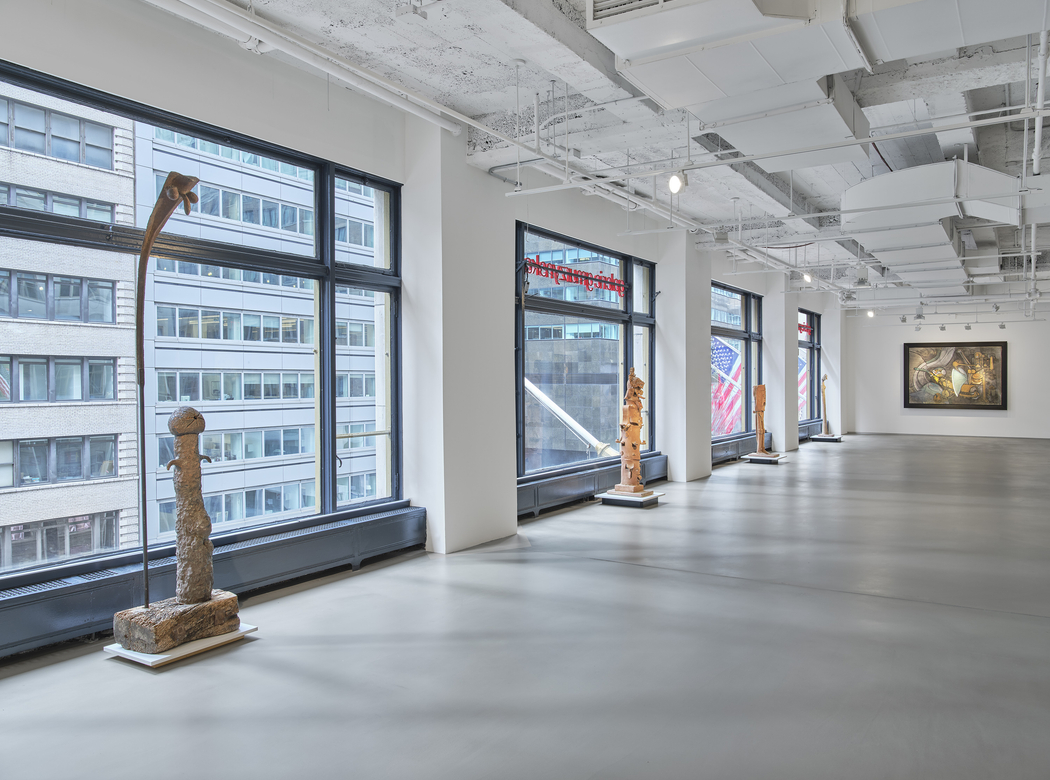
Today, Galerie Gmurzynska is located on Paradeplatz in Zurich. The gallery features the last interior exhibition architecture of Zaha Hadid, which was conceived for the DADA centennial in June 2016 on the occasion of a major Kurt Schwitters retrospective, reimagining the 21st century Merzbau. The project has been finished with Patrik Schumacher and the team of Zaha Hadid Architects, shortly after unfortunately Hadid passed away unexpectedly.

Galerie Gmurzynska St. Moritz
The second Zurich location was opened on June 10th, 2017 at Talstrasse 37 with a JUDD / MALEVICH duo show that has been curated by Flavin Judd the co-president of the Judd Foundation. The exhibition is accompanied by an extensive publication of over 260 pages and hitherto unpublished documentary material.
Additionally in the same year the Galerie Gmurzynska US Inc. was founded and is located in New York on 39 East 78th Street at the corner of Madison Avenue.
Both Krystyna Gmurzynska and Mathias Rastorfer were awarded the Chevalier des Art et des Lettres by the French Minister of Culture.

Part of Galerie Gmurzynska’s extensive research library.
test